
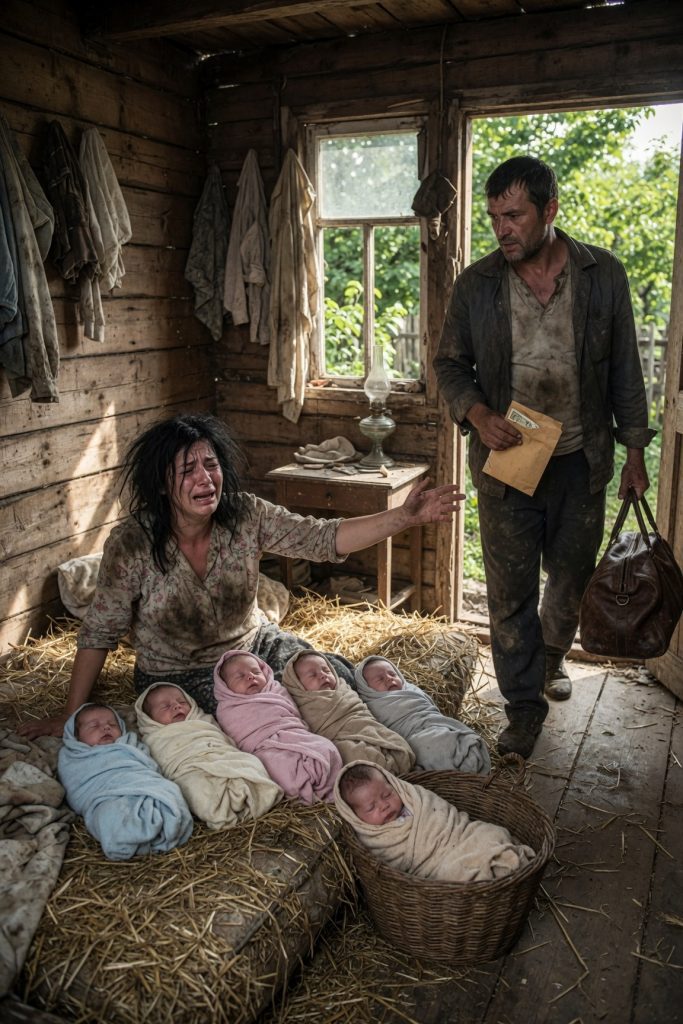
He Called His Five Newborn Babies a “Curse” and Walked Out—30 Years Later, He Saw Their Names in the Newspaper and Came Running Back
In 1995, inside a tiny, weather-beaten house on the edge of rural Kentucky, five newborn babies cried at the same time.
Not one. Not two. Five.
Their mother, Maria, lay on an old mattress in the corner of the room, pale, trembling, and barely able to keep her eyes open. She had just given birth to quintuplets in a house so poor the windows rattled in the wind and the roof leaked whenever it rained.
The babies were wrapped in mismatched blankets and placed carefully in a laundry basket near the bed because Maria couldn’t afford a proper crib. Three of them were crying for milk, one was kicking weakly, and the smallest one had a tiny hand curled around the edge of the blanket like he was already fighting to stay in the world.
But there was no celebration in that house.
No proud father.
No happy tears.
Only Ramon standing in the doorway, staring at the five babies as if they had ruined his life.
“Five?” he shouted, his voice shaking the walls. “Maria, are you serious? Five children?”
Maria tried to sit up, but her body was too weak. “Ramon, please,” she whispered. “They’re our babies.”
“Our problem,” he snapped.
He began pacing the room, running his hands through his hair like a trapped man. Bills were already stacked on the kitchen counter, the refrigerator was nearly empty, and the old pickup truck outside barely started anymore.
“We can barely afford to feed ourselves,” he shouted. “Now you expect me to feed five more mouths?”
Maria’s eyes filled with tears.
“We’ll work harder,” she said. “I’ll take any job. We can survive if we stay together.”
But Ramon wasn’t looking at her anymore.
He was looking at the babies.
Not with love.
Not even with fear.
With resentment.
“I didn’t sign up for this life,” he said coldly. “I wanted to get out of this town. I wanted to be somebody. These kids are a curse.”
The words hit Maria harder than any pain from childbirth.
A curse.
That was what he called them.
Five innocent babies who had been alive for only a few hours.
Maria clutched the closest baby to her chest and cried silently while Ramon grabbed an old duffel bag from the closet. He shoved clothes inside, took his jacket from the chair, and moved around the room like a man escaping a fire.
Then he stopped.
His eyes went to the pillow on Maria’s bed.
Maria froze.
“Ramon,” she said weakly. “Don’t.”
He lifted the pillow and pulled out a small envelope.
Inside was the only money Maria had saved: $382 from washing clothes, cleaning houses, and selling homemade food after church. It was supposed to buy formula, diapers, and medicine for the babies.
“Please,” Maria begged. “That money is for the children.”
Ramon looked at the envelope, then at her.
“Consider it payment,” he said, “for the mess you brought into my life.”
Then he walked out.
No goodbye.
No kiss on the babies’ heads.
No promise to come back.
That same night, Ramon boarded a Greyhound bus headed for Chicago with Maria’s last $382 in his pocket.
He never looked back.
Behind him, in that broken little house, were a woman too weak to stand and five newborn babies crying into the dark.
The years that followed nearly destroyed Maria.
She had no husband, no savings, no steady help, and five children who needed food, shoes, school supplies, doctor visits, and comfort when the world treated them like a mistake.
In the mornings, she cleaned motel rooms.
In the afternoons, she worked at a small grocery store.
At night, she washed dishes at a roadside diner until her hands cracked and bled from soap and hot water.
Some nights, she came home so tired she fell asleep sitting on the floor while the babies crawled around her.
But she still got up every morning.
Because mothers like Maria don’t have the luxury of giving up.
The neighbors were not always kind.
Some whispered when she passed.
Others laughed openly.
“There goes Maria with her little army,” one woman said outside the church.
“No wonder her husband left,” another muttered. “Five kids would scare any man away.”
Maria heard every word.
But she never answered.
She kept walking.
She kept working.
She kept feeding her children, even when it meant she went to bed hungry herself.
There were nights when dinner was nothing but white rice with butter.
There were mornings when she watered down the milk so it would last one more day.
There were winters when all five children shared coats from donation bins, and Maria smiled like everything was fine so they wouldn’t feel ashamed.
But every night, before they slept, she gathered all five of them close in their small bedroom.
Their names were Daniel, David, Grace, Hannah, and Michael.
Five children.
Five hearts.
Five reasons she refused to break.
“Listen to me,” she would whisper. “You are not a burden.”
The children would look at her with tired eyes.
“You are not a mistake,” she continued. “And you are not a curse.”
Sometimes Daniel, the oldest by seven minutes, would ask, “Then why did Dad leave?”
Maria’s face would change, but she never let bitterness poison them.
“Because some people run from responsibility,” she said softly. “But one day, you will show the world what he was too blind to see.”
Those words became their fire.
The five children grew up poor, but they did not grow up hopeless.
Daniel studied under streetlights when the electricity got cut off and later became a respected attorney.
Grace worked weekends at a bakery to buy used textbooks and became a surgeon.
David fixed broken radios and old computers from junkyards until he built a tech company that changed his life.
Hannah became a judge, known for protecting children and mothers who had nowhere else to turn.
And Michael, the smallest baby Ramon had never even held, became a state senator with a voice people trusted.
Thirty years passed.
Maria’s hair turned gray.
Her hands grew stiff from years of work.
But the children she raised from nothing became names people recognized across the country.
And then one morning, in a cheap motel room outside Chicago, an old man sat alone with a gas station coffee and a newspaper in his shaking hands.
His name was Ramon.
He had aged badly.
The dreams he had chased never became the life he imagined. The city swallowed him, the jobs disappeared, the women left, and the money never stayed.
For decades, he told himself he had escaped poverty.
But all he had really escaped was responsibility.
Then he saw the headline.
“Kentucky Quintuplets Raised by Single Mother Honored for Changing Thousands of Lives.”
Under the headline was a photograph.
Five adults standing beside an elderly woman in a blue dress.
Maria.
Ramon’s coffee slipped from his hand.
His breath caught in his throat.
He stared at the faces in the newspaper, one by one, and realized the five babies he had called a curse had become powerful, respected, and wealthy enough to change the lives of everyone around them.
And at the center of the photo was Maria.
The woman he abandoned.
The woman whose last $382 he stole.
The woman who had raised five children alone while he disappeared.
For the first time in thirty years, Ramon whispered their names.
Then he folded the newspaper, put it in his jacket pocket, and stood up.
Because now that his children were successful, now that cameras loved them, now that the world admired them, Ramon decided it was time to come back.
But he had no idea Maria had kept one thing from the night he left.
One thing that would make all five children finally learn the truth.
————————————————————————————————————————
Year 1995.
You were born in a small, nearly collapsing wooden house on the edge of a poor farming town in Mississippi. The roof leaked every time it rained, the floorboards bent under bare feet, and the kitchen had more empty jars than food. That night, five babies cried at once, five tiny voices rising into the humid Southern air like the world itself was being warned that your lives would not be easy.
Your mother, Maria Dawson, lay on an old bed with sweat on her forehead and tears in her eyes. She had just given birth to quintuplets. Five babies. Five fragile bodies wrapped in faded blankets. Five mouths needing milk in a house that barely had enough rice, beans, and canned soup to survive the week.
Your father, Ramon Dawson, did not look at you with wonder. He looked at you like you were a sentence handed down by a cruel judge. He paced the room with a cheap duffel bag in his hand, breathing hard, his face twisted with anger.
“Five?” he shouted. “Maria, five? We can barely feed ourselves, and now you bring five more mouths into this house?”
Your mother tried to sit up, but her body was too weak. “Ramon, please,” she whispered. “They’re your children. They need you. I need you.”
But your father was already gone in his heart.
He looked at the five of you as if you had stolen his future. He did not see babies. He saw bills. He saw diapers. He saw work. He saw responsibility. And Ramon Dawson hated responsibility more than he loved his own blood.
“I’m not dying in this shack,” he said. “I’m not wasting my life because of this.”
Your mother cried harder. “Please don’t leave us.”
Then he said the words that would follow you for the rest of your lives.
“These children are a curse.”
The room went silent except for the babies crying.
Your mother held two of you against her chest while the other three screamed from a basket lined with towels. She was too weak to stand, too exhausted to fight, and too heartbroken to understand how a man could walk away from his newborn children on the same night they entered the world.
Then Ramon did something worse.
He went to the old dresser, lifted a cracked wooden jewelry box, and pulled out an envelope. Inside was the money your mother had saved for formula, medicine, and a doctor’s visit. It was only $312, but in that house, $312 was survival.
“Ramon,” your mother begged. “No. That money is for the babies.”
He shoved it into his pocket.
“Consider it payment for all the trouble you gave me.”
Then he walked out.
He did not kiss your mother. He did not touch your heads. He did not even look back from the doorway. He got into an old gray bus heading toward Chicago and disappeared into the night like a coward wearing the shape of a man.
Behind him, your mother was left with five newborn babies and no money.
That was the first thing your father ever gave you.
Absence.
For years, your mother survived on exhaustion.
She cleaned houses in the morning, washed dishes in a diner in the afternoon, and folded laundry at night for families who looked down on her. She came home with cracked hands, swollen feet, and eyes so tired they seemed older than her body. But the moment she opened the door and saw the five of you, she smiled anyway.
You were named Grace, Hope, Daniel, Elijah, and Ruth.
Your mother said she chose those names because one day, when life became too heavy, you would need to remember what you were made of. Grace, because kindness could survive poverty. Hope, because darkness never lasted forever. Daniel, because courage could stand in front of lions. Elijah, because miracles sometimes arrived through fire. Ruth, because loyalty could rebuild a broken family.
The town was not kind.
People whispered when your mother walked by with five children trailing behind her like ducklings. Some laughed from porches. Some shook their heads in fake pity. Some said Ramon had been smart to leave before all those babies dragged him under.
“There goes Maria and her little curse,” one woman said outside church one Sunday.
You were only six, but you heard it.
All five of you heard it.
Your mother heard it too.
She stopped walking.
For a second, you thought she would turn around and finally say something. Instead, she knelt in front of you, straightened Daniel’s collar, wiped dirt from Ruth’s cheek, and said softly, “Stand tall. People who don’t understand blessings often mistake them for burdens.”
That became the sentence you carried.
Blessings, not burdens.
Your childhood was not easy, but it was not empty.
You slept three to a mattress some nights. You shared shoes until the soles split open. You ate oatmeal for dinner more times than you could count. There were birthdays with no cake, Christmas mornings with one wrapped gift between all five of you, and school field trips your mother pretended to forget because she could not afford the fee.
But she gave you what money could not.
She gave you discipline.
Every night, no matter how tired she was, your mother made you do homework at the kitchen table. The light above it flickered. The chairs did not match. Sometimes the table was sticky from jelly because Ruth was small and messy. But Maria Dawson stood over that table like it was Harvard University.
“Your mind is the one thing poverty cannot steal unless you hand it over,” she would say.
Grace became the reader. She loved books so much she would read cereal boxes when there were no library books left. Hope became the negotiator, the one who could talk teachers into giving extra time, neighbors into lending tools, and store owners into saving bruised apples for half price.
Daniel became the protector. He fought anyone who insulted your mother, even when he was outnumbered. Elijah became the builder, always taking apart broken radios, fans, and bicycles to see if he could make them work again. Ruth, the youngest by eleven minutes, became the watcher. She noticed everything, remembered everything, and spoke only when her words mattered.
Together, you became a unit.
If one of you had a sandwich, all five ate. If one got bullied, all five stood together. If one won an award, all five clapped like the ceiling might fall. You were not just siblings. You were evidence that your mother’s suffering had not been wasted.
Your father became a ghost story.
You knew his name. You knew he had left. You knew he had stolen the formula money. But your mother never let hatred become the foundation of your home.
“Don’t let him make your hearts ugly,” she said one night when Daniel asked if Ramon was dead.
“Is he?” Daniel asked.
Maria looked at the window for a long moment. “No. But some people are alive and still absent.”
“Do you hate him?” Grace asked.
Your mother’s eyes filled with something complicated.
“No,” she said. “But I stopped waiting for him.”
That was the day you learned there was a difference.
Years passed.
The five of you became teenagers, then adults, and the town that once mocked you began to watch you differently. Grace won a full scholarship to Duke University. Hope earned her way into law school after working two jobs through college. Daniel joined the Army, served with honor, and later became a decorated state police commander. Elijah built his first software company from a used computer he repaired himself. Ruth became a surgeon after years of studying under library lights and hospital vending-machine dinners.
Your mother never missed a graduation.
Not one.
She wore the same blue dress to every ceremony because it was the nicest one she owned. She clapped until her hands hurt. She cried quietly when no one was looking. And every time one of you crossed a stage, she whispered, “Blessing.”
By 2025, thirty years after Ramon walked out, the Dawson quintuplets were no longer poor children in a falling-down house.
Grace Dawson was a best-selling author and education advocate whose nonprofit had opened learning centers across the South. Hope Dawson was a federal prosecutor known for taking down corrupt businessmen and powerful men who thought money could protect them. Colonel Daniel Dawson had become one of the most respected law enforcement leaders in Georgia.
Elijah Dawson was a tech founder whose company had sold for $82 million, and he used a large part of that money to fund rural broadband access. Dr. Ruth Dawson was a nationally respected pediatric heart surgeon in Atlanta, known for operating on children whose families could not afford expensive care.
And Maria Dawson?
She lived in the same Mississippi town, but not in the same crumbling house.
You had rebuilt it for her.
Not as a mansion. She refused that. Your mother said she did not need marble floors to know she was loved. So you built her a warm white farmhouse on the same piece of land, with a wide porch, a garden, a strong roof, and a kitchen big enough for all five of you to come home at once.
On the thirtieth anniversary of your birth, a national newspaper ran a feature story.
The headline read:
“The Five Dawson Children: From Rural Poverty to Power, Raised by a Mother Who Refused to Give Up.”
The article showed a photograph of all five of you standing behind Maria on her porch. Grace in a cream suit, Hope in navy, Daniel in uniform, Elijah with his sleeves rolled up, and Ruth in a white doctor’s coat. Your mother sat in the center, silver now in her hair, smiling like the richest woman in America.
That morning, in a cheap motel outside Chicago, Ramon Dawson saw the newspaper.
He was seventy-one years old.
His hands shook as he held the page.
At first, he did not recognize you. How could he? The last time he saw you, you were five crying newborns wrapped in faded blankets. But then he saw Maria’s name. Then his own surname. Then the article mentioned the father who disappeared the night they were born.
Ramon sat down slowly on the edge of the bed.
The article did not call him cruel. It did not insult him. It simply told the truth. He had left. Maria had stayed. The children had risen.
That was what destroyed him.
Not being hated.
Being unnecessary.
Ramon had spent thirty years telling himself he had made the right choice. He told himself no man could have raised five children in poverty. He told himself Maria probably remarried. He told himself the children would never know what he did. Most of all, he told himself he had escaped a curse.
Now the “curse” had become powerful.
And he was alone.
His second marriage had failed. His restaurant job had ended after his knees gave out. His friends had disappeared. His savings were gone. He lived in weekly motels and counted quarters for coffee.
So he did what selfish people often do when the consequences finally find them.
He called it regret.
But it was need.
Three weeks later, Ramon arrived in Mississippi.
He stepped off a Greyhound bus with an old suitcase, a wrinkled shirt, and a face carved by years of hard living. The town had changed, but not enough to hide from memory. The road was paved now. The diner had new windows. The church had a bigger sign.
But the land where he abandoned his family was still there.
Only the house was different.
Ramon stood at the gate of Maria’s new farmhouse and stared.
The porch was clean. Flowers grew along the walkway. A wind chime moved softly in the breeze. On the wall beside the front door hung a wooden sign that read:
The Dawson Home — Built by Love, Not Luck.
He swallowed.
For the first time in thirty years, Ramon Dawson felt small.
Maria saw him from the kitchen window.
She did not scream.
She did not drop the cup in her hand.
She simply stood still.
The man who had once walked out carrying her milk money now stood outside her gate like a beggar approaching a church.
Grace was the first to arrive that afternoon. Hope came next, then Daniel, then Elijah, then Ruth, still in scrubs from the hospital. Maria had called only once and said, “Your father is here.”
No one asked which father.
There had only ever been one man with that title by blood.
Never by love.
You all gathered on the porch while Ramon stood below the steps.
For a moment, nobody spoke.
He looked at your faces, searching for traces of babies he had never known. Grace had Maria’s eyes. Hope had his jawline, though she hated when anyone said it. Daniel had his height. Elijah had his hands. Ruth had his dark hair.
But none of you had his weakness.
Ramon removed his cap.
“Maria,” he said.
Your mother sat in her porch chair, calm as Sunday morning. “Ramon.”
His eyes filled quickly, too quickly. “I came a long way.”
Daniel crossed his arms. “No one asked you to.”
Ramon flinched. “I deserve that.”
Hope’s voice was cold. “You deserve more than that.”
Grace studied him quietly. Ruth said nothing at all. Elijah leaned against the porch post, watching the man who had left them with the curiosity of someone studying a broken machine.
Ramon looked at all five of you. “I know I made mistakes.”
Daniel laughed once, without humor. “Mistakes? You stole money from a woman who had just given birth to five babies.”
Ramon’s eyes dropped.
“I was scared,” he said.
Hope stepped forward. “So was she. She stayed.”
That sentence hit harder than shouting.
Ramon looked at Maria, perhaps expecting her to soften. Perhaps expecting the woman he left behind to still be the young, exhausted mother begging him not to go. But Maria was not that woman anymore. She had been transformed by thirty years of survival into something stronger than rage.
“I thought about this day,” Maria said quietly. “Not every day. Not after a while. But sometimes.”
Ramon’s mouth trembled. “I’m sorry.”
The words floated between you.
Small words.
Late words.
Words that should have arrived thirty years earlier with formula in his hands and shame on his knees.
Ruth finally spoke.
“Why are you here?”
Ramon looked at her.
She did not blink.
“I saw the article,” he admitted.
Of course.
No one reacted, but everyone felt it.
He had not come because guilt woke him at night. He had not come after birthdays, graduations, surgeries, hunger, eviction threats, or years of silence. He had come after seeing your names in a newspaper.
Grace’s eyes narrowed. “So you came after learning we were successful.”
Ramon shook his head quickly. “No. I mean, yes, I saw it, but that’s not why. I wanted to see my family.”
Daniel stepped down one stair. “You don’t have a family here. You have blood here. There’s a difference.”
Ramon’s eyes filled again. “Please. I’m old. I’m sick. I don’t have anyone.”
There it was.
The truth.
Not “I have loved you from afar.”
Not “I have carried shame every day.”
Not “I want to make amends before I die.”
I don’t have anyone.
You understood then that Ramon had not come looking for his children.
He had come looking for shelter.
Maria closed her eyes briefly.
When she opened them, there was pain in them, but not confusion. She had known from the moment she saw him at the gate.
“What do you want, Ramon?” she asked.
He hesitated.
Hope caught it immediately. Prosecutors know when a person is deciding how much truth to admit.
“I need help,” he said finally. “I have medical bills. I have nowhere stable to live. I thought maybe…” He looked at the farmhouse, then at all five of you. “Maybe my children could help their father.”
The word father landed badly.
Daniel’s face hardened.
Elijah looked away.
Grace’s eyes filled with tears, but she did not let them fall.
Ruth’s voice was quiet. “You don’t get to use that word like it costs nothing.”
Ramon took a step closer. “I know I wasn’t there.”
“You weren’t absent because life took you away,” Ruth said. “You chose to leave.”
“I was young.”
“So was Mom.”
“I was poor.”
“So were we.”
“I was afraid.”
“So were five newborn babies.”
Ramon had no answer.
Because there was none.
Maria stood slowly, and all five of you turned toward her. Even now, after everything, her voice still mattered most. She walked to the porch railing and looked down at the man she had once begged to stay.
“You called them a curse,” she said.
Ramon covered his face with one hand.
“I know.”
“No,” Maria said. “You remember saying it. But you don’t know what it did.”
Her voice trembled, but she continued.
“You don’t know what it was like to hold five hungry babies and hear that word in my head. You don’t know what it was like to hear neighbors repeat it. You don’t know how many nights I cried into a towel so they wouldn’t hear me.”
The porch went silent.
“You left me with nothing,” Maria said. “And still, I told them not to hate you.”
Ramon looked up, startled.
Grace turned to her mother. “You did.”
Maria nodded. “Because I didn’t want his failure to become your poison.”
Ramon began to cry.
This time, it looked real.
But real tears do not erase real damage.
Hope stepped beside Maria. “We can arrange medical care through a public assistance program. We can connect you with a senior housing organization. We can make sure you don’t die on the street.”
Ramon looked up with hope.
Then Hope finished.
“But you will not live here.”
His face fell.
Daniel added, “And you will not call reporters.”
Elijah said, “You will not use our names for money.”
Ruth said, “You will not approach Mom without permission.”
Grace said, “And you will not rewrite the story.”
Ramon looked from face to face, realizing the door was not opening the way he imagined. Maybe he had pictured crying, forgiveness, a warm meal, a bedroom, a reunion photograph. Maybe he thought successful children would be eager to prove they were better by rescuing the man who abandoned them.
But you were better.
That was why you had boundaries.
Ramon’s voice cracked. “You’re really going to turn your back on me?”
Daniel’s jaw tightened, but Maria raised one hand to stop him.
She looked at Ramon with tired compassion.
“No,” she said. “That is what you did. What they are doing is protecting the home you abandoned.”
Ramon stared at her.
For the first time, he seemed to understand the difference.
He sat on the lowest porch step, suddenly looking smaller than all the memories you had built around him. For a while, no one moved. The sun lowered behind the trees, throwing gold across the yard.
Then Grace went inside and returned with a glass of water.
She handed it to him.
Not because he deserved it.
Because she was Maria’s daughter.
Ramon drank with shaking hands.
“I don’t know how to fix this,” he whispered.
Hope answered, “You don’t fix thirty years. You tell the truth and stop asking victims to pay for what you broke.”
That became the beginning of his consequence.
Not revenge.
Consequence.
The next few months were strange.
Hope arranged legal paperwork so Ramon could receive aid without touching your family assets. Ruth connected him with a clinic that treated low-income seniors. Elijah paid a one-time deposit for a small assisted living room, but he did it anonymously through an agency because he refused to let Ramon mistake help for closeness.
Daniel made sure there were clear boundaries.
Grace wrote nothing about him publicly.
That may have been the greatest mercy of all.
Ramon tried to visit Maria twice without calling. Both times, Daniel stopped him. The third time, Ramon called first. Maria said no. He did not come.
That was progress.
Small, late, imperfect progress.
One year later, Maria became ill.
At first, she hid it. Mothers like her always do. She called it tiredness, then age, then too much gardening. But Ruth noticed the weight loss, the fainting spell, the way Maria held the kitchen counter when she thought no one was watching.
The diagnosis came in the fall.
Heart failure.
Treatable, manageable, but serious.
For the first time in your lives, the five of you felt like children again.
You were powerful in the world. You had money, influence, degrees, authority, connections. But none of it made you ready to imagine life without the woman who had held your universe together with cracked hands and stubborn love.
Maria accepted the diagnosis calmly.
“You all look like someone died,” she said from her hospital bed. “Stop that.”
Grace cried anyway.
Daniel turned toward the window.
Ruth explained the treatment plan, though everyone knew she was explaining it partly to keep herself from breaking. Elijah started researching the best cardiac specialists in the country. Hope began organizing schedules before anyone asked.
Maria watched all five of you and smiled.
“My blessings,” she whispered.
Ramon heard about her illness through the agency caseworker.
He asked to see her.
At first, you all said no.
Then Maria asked for him.
No one liked it, but everyone respected it.
Ramon came to the hospital in a clean shirt, carrying no flowers because he said he did not know what she liked anymore. That honesty surprised you. He stood in the doorway like a man approaching sacred ground.
Maria looked smaller in the bed, but her eyes were still sharp.
“You came,” she said.
“You asked.”
A faint smile touched her lips. “Thirty-one years late, but you followed one instruction.”
Ramon laughed through tears.
It was the first time any of you heard him laugh without bitterness.
Maria looked at you all. “Give us a minute.”
Daniel immediately objected. “Mom—”
“Daniel,” she said gently.
He stopped.
The five of you stepped outside, but Hope left the door cracked. Maria would have scolded her if she noticed. She probably did notice and let it happen.
Inside, Ramon sat beside the bed.
“I ruined your life,” he said.
Maria turned her head toward him. “No. You made it harder. There’s a difference.”
He cried quietly.
“I thought if I came back and said sorry, maybe…” He stopped. “Maybe I could be someone else.”
Maria’s voice softened. “You can become someone better. But you cannot become someone who stayed.”
That sentence stayed with all of you.
You cannot become someone who stayed.
Ramon bowed his head.
“I saw them,” he whispered. “Our children. What they became. And I keep thinking… I missed everything.”
“Yes,” Maria said. “You did.”
No comfort.
No cruelty.
Just truth.
He wiped his face. “Do they hate me?”
Maria was quiet for a long moment.
“No,” she said finally. “But they don’t need you. That may hurt more.”
It did.
You saw it on his face when he came out.
Something in him had collapsed, but maybe something honest had finally taken its place.
Maria lived another four years.
Beautiful years.
Years filled with Sunday dinners, grandnieces and nephews, porch music, community events, and quiet mornings where she drank coffee under the oak tree you planted for her. She saw Grace open her tenth learning center. She saw Hope appointed U.S. Attorney for the district. She saw Daniel retire with honor. She saw Elijah launch a foundation. She saw Ruth receive a national medical award.
Ramon remained at the edge of the story.
Not inside the home.
Not fully outside it.
He sent birthday cards. Sometimes you read them. Sometimes you did not. He attended public events quietly, standing in the back, never asking for photos. He never again called himself a father in front of you unless one of you allowed it.
At Maria’s funeral, the church overflowed.
People came from across the country. Former students from Grace’s nonprofit. Lawyers who respected Hope. Officers Daniel had led. Engineers Elijah had mentored. Families whose children Ruth had saved. And townspeople who once mocked Maria now stood in line to honor her.
The pastor spoke of sacrifice.
Grace read a poem.
Daniel carried the casket with tears streaming down his face.
Ruth placed five white roses on top, one for each child Maria refused to see as a curse.
Ramon sat in the last pew.
Alone.
After the burial, he approached slowly. He looked older than ever, his shoulders curved inward, his eyes red. For once, he did not ask for anything.
He stood before the five of you and removed his hat.
“Your mother was the strongest person I ever knew,” he said.
No one argued.
Then he looked at each of you.
“I don’t deserve to stand with you. I know that. But I need to say this while I can.” His voice broke. “You were never a curse. I was the curse I left behind.”
The words struck the air hard.
Grace covered her mouth.
Hope looked down.
Daniel’s face tightened.
Elijah closed his eyes.
Ruth cried silently.
Ramon continued. “I spent thirty years blaming babies for my cowardice. I called you a burden because I was too weak to carry love. Your mother carried what I ran from, and she turned it into something beautiful.”
For the first time, he did not ask to be forgiven.
That mattered.
He simply bowed his head and walked away.
Three months later, Ramon died in his assisted living room.
There was no dramatic final reunion. No hospital bedside confession. No perfect family photograph. Just a call from the facility, a quiet funeral, and five adult children standing at a grave trying to understand how grief could exist for a man they barely knew.
You buried him beside no one.
That was his choice, in the end.
But on his simple stone, Grace insisted on one line.
May truth arrive earlier in the next life.
Some people thought it was too kind.
Some thought it was too sad.
You thought it was honest.
Years later, the old story still followed you. Reporters asked about it. Strangers cried when they heard it. People wanted to know how five abandoned children became powerful, how a poor mother survived, how a father could leave and return only after success made regret convenient.
You always answered carefully.
Because the story was never really about Ramon.
It was about Maria.
It was about the woman who had five babies, no money, no husband, and every reason to give up—but didn’t. It was about the mother who washed other people’s clothes while dreaming of college for her children. It was about the woman who taught you that poverty could bruise the body but did not have to own the soul.
Ramon called you a curse.
The world called you unlikely.
Your mother called you blessings.
And in the end, only one of them was right.
On the thirtieth anniversary of the day your father returned, the five of you gathered again at the farmhouse. The porch was older now. The oak tree was taller. Maria’s chair still sat by the window, empty but never forgotten.
Grace brought books for the learning center.
Hope brought files because she never stopped working.
Daniel grilled in the backyard.
Elijah fixed the porch light without being asked.
Ruth sat in Maria’s chair for the first time and cried so quietly no one interrupted.
At sunset, you all stood together in the yard where your mother had once carried laundry baskets with cracked hands and a straight back. The same land where Ramon abandoned you. The same land where Maria raised you. The same land where the word “curse” had been buried forever.
Grace raised a glass.
“To Mom,” she said.
“To Mom,” you all answered.
And somewhere in the warm evening air, it felt like Maria was still there, smiling from the porch, reminding you of the truth she had spent her life proving.
You were never a burden.
You were never a curse.
You were five blessings born into hardship, raised by courage, and sharpened by love.
And when the father who rejected you came looking for power, money, and shelter, he found something he had never understood.
A family does not become strong because a man stays.
Sometimes, a family becomes strong because a woman refuses to fall apart after he leaves.
That was Maria’s victory.
That was your inheritance.
And that was the legacy no one could ever steal.